
Skyrocketing fuel prices make some of us think twice before heading out for a drive. It’s become an ongoing challenge to find fun places closer to home.
Which brings us to the shoreline of the Coos Bay Estuary in the Barview district. You can explore it on foot or in a vehicle. Destinations range from little-visited beaches to an unusual geological phenomenon with the tantalizing name of The Giants.
To see some of it, you can walk along the bayshore beach south of the Empire Boat Ramp (also known as the Hollering Place). Or, drive south on S. Empire Blvd. and make stops along the way.
You can turn around at any point. Waterproof footwear is a must
Perhaps the most important thing to remember is that the beaches, shoreline and little coves all get inundated at high tide. You wouldn’t even know there was anything there (but water) when the tide’s in.
Other times it all looks like gooey mudflats. But while there is indeed a fair amount of goo, there’s also plenty of firmer footing.
You get a sense of it almost immediately beginning with a walk from the aforementioned Hollering Place, which is at the western end of Newmark Ave. in Coos Bay’s Empire district. (The name comes from earlier times when people who wanted to cross the channel could call out for assistance in getting back or forth.) At low tide, the beach here is surprisingly wide, with firm, well-packed sand. But not far along is the first mudflat. Here as elsewhere, find firmer footing atop salt-tolerant pickleweed just above the wrack line.
This beach encounters an area where the water is too high (or deep) to cross, even at low tide, so backtrack out.
A longer stretch of sandy shoreline begins at the foot of Fulton St., with potential for bird-watching, sand castle-building, or just sitting on a driftwood log and admiring the view. If you’re driving, it’s 7 blocks (0.6 mile) south of the Hollering Place.
Not far down the beach is Crab Flats, covered with broken beachglass bits and ceramic shards, remnants presumably of early-day trash dumping. Next is a former sawmill site, with decaying pier and pilings. It’s now an upscale RV park, and the beach remains open.
Next are popular clamming flats. The next landmark is Pigeon Point, followed by another cove. If you’re driving, it’s 2.5 miles from the Hollering Place to just past Beacon Ln., next to utility building 3215.
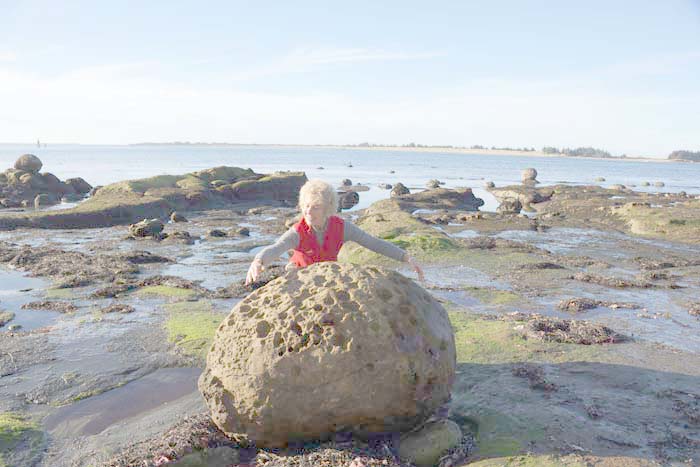
Walk across the cove southward on a beach of mud, slippery stones and moss. Around the corner the footing changes yet again, with rock shelves embedded with fossilized cockles and clams. Most intriguing are the massive spherical formations known as The Giants, formed eons ago in a complicated process that takes in elements of geology, biology, chemistry, soil science and meteorology, and yet is still not fully understood.
Science aside, The Giants are a sure-fire fun destination, and might even increase your appreciation for this often-overlooked part of the bay.
(Shopper columnist Tom Baake is author of regional guidebooks.)


